 When evaluating the recent Google Profiles it is not by chance that Google, after having one of the first successful communities (Orkut) has never invested in its promotion and development. At least nothing comparable to what you did with GMail, Google Calendar, Google Reader, Google Maps, Google Docs, among many more projects, applications and services (Orkut was always something external to Google; a bastard project).
And it's not that Google doesn't believe in Social Networking. Quite the opposite! The truth is that instead of competing directly with a Facebook, MySpace, Hi5 and everyone else, it prefers to position itself as an “enabler” while keeping the focus where it interests you: information.
As more and more platforms appear on the market, the selection of these platforms is becoming increasingly complex. Creation costs are increasing and selection decisions will focus on one/two platforms according to cost/benefit analysis.
Instead of launching another Social Networking platform, Google is betting on being facilitator, or “enabler”, providing developers with simple ways to create applications that work and share information on all social networks.
In fact, Google’s Social Networking strategy goes a little further:
1. Open Social : Last year Google launched a set of APIs (programming interfaces), called Open Social, which enable programmers to access the main functionalities, and data, of social networks. These APIs are divided into 3 sets:
- Profile information (user data);
- Information of friends (social graph);
- Activities (what happened, news, etc.).
To the Open Social they joined: MySpace, hi5, linkedin, plaxo, orkut (clear), friendster, ning, Bebo, xing, Six Apart, SalesForce, Viadeo, Oracle, engagement.com, iLike, RockYou, Slide, imeem, Hyves, Tianji, among other networks that come together...
The network that keeps out, closed: Facebook. Until when?
2. OpenID: Google has assumed the use of OpenID, not in the open perspective of the single user/password but while providing OpenID with GMail address. Google's goal is to allow GMail's email address to be the unique "Login". This is actually one of Google’s first unopened steps... but one understands how much GMail is reinforced by revenge...
3. OAuth: after Blaine Cook and Chris Messina have begun the development of OAuth as an open protocol to allow secure authorization of APIs, allowing web, mobile or Desktop applications to publish and interact safely with protected data, Google joins the initial Draft team in 2007.
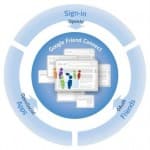
Taking advantage of the “ Open Social “, “ OpenID ” and “ OAuth “, Google anticipates and launches the Google Friend Connect, an ambitious step that makes this strategy very clear: Let’s Get Social!
Any site, regardless of the size, can now have social networking features. Simply add Google Friend Connect Widgets to take advantage of links between users. And at a time when the Chat Marketing ” gains momentum... it makes a lot of sense to provide tools that increase conversation... on the site itself!
Google Friend Connect actually goes a little further because it not only joins the 3 open standards I described as APIs that own Facebook, MySpace and Google themselves. That is, it not only anticipates itself but takes advantage of Facebook’s “closed” and “protective” postures.
For all this... Let’s Get Social!