 After acquiring the VoIP operator in July 2007 GrandCentral and if you thought you were going to let the service die, Google announced just over a week ago its relaunch through the Google Voice.
Like the first days of VoIP, many point to the service as a serious threat to the telecommunications industry and, new, to the VoIP industry itself (read, existing IP Voice Operators and Skype).
If Google searches revolutionized the Web, and GMail revolutionized free email, Google Voice can revolutionize the Voice world.
What's new with Google Voice?
No big news. Only the name “Google” and a “killer app”.
In my past VoIP times Netcall ), I have always argued that VoIP did not have a direct business model and that it would only be sustainable when associated with business with financial and market muscle that they saw in VoIP, and in general voice, a “commodity” and lever to bring added value to other services. At the time, this “muscle” was obvious in the world of telecommunications operators and in the need to create Triple Play packages (voice + video + Internet).
It is curious that after eBay’s inconsequential purchase of Skype, it is now a very consequent Google that more than “muscle” brings the focus on the user, patience and web vision to take real advantage of the convergence of voice and data services.
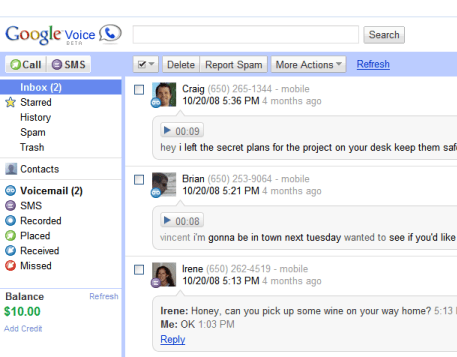
However, Google Voice is nothing more than the materialization of everything VoIP has promised since 2003:
-
a unique number (Google Number) that will allow you to reach all your phones;
-
an IP Personal Centrex, a kind of virtual operator with all the features that define this type of service;
-
a management web interface;
-
Cheaper international calls.
To which Google adds:
-
a new, simple and cleaner (Google like) interface;
-
good SMS treatment;
-
free telephone conferences;
-
integration with GMail contacts;
-
textual transcription of voice mail.
The Google Voice “killer app” is precisely the textual transcription of voice mail, allowing “read” voicemails while we are on the phone, in meetings, etc.. In other words, we are not required to listen to messages.
It is most likely by this feature that Google's interest in voice arises since when transcribing voice messages, these become indexable, like any page Web or email, and to be able to feed the AdWords Google business.
No wonder AdWords campaigns are starting to appear based on phone conversations.
The Google factor
Despite a number of issues that the service raises, Google's strategy is once again annoyingly coherent and worrying.
Quoting Phil Wolff, editor of Skype Journal, “the possibility of transforming the rules of the game by the ability to bring all kinds of people to their new tools from existing tools”.
GMail revolutionized the mail and is today more than just an email reader, a contact and communications center. In addition to the interface, it integrates email, sms, voice, video and Instant Messaging.
Google Voice turns out to be just another step forward in Google's strategy and risks being its 4th largest service (after search, adwords and Gmail).
Despite this, there are challenges and barriers that, even for Google, will not be simple to manage.
Privacy
With Google Voice, Google gets even more information about our lives, including recordings of our voicemails and possibly phone calls. In addition to the information about the content of calls, Google learns who and when to call us. If we add up what Google already knows about us, this could mean the ultimate end of privacy.
As you already do today in GMail, when you transcribe your voice to text, it won't be surprising that in the short term we begin to have advertising (AdWords) based on our topics of conversation.
Of course, as in all previous services it is easy to say “if you don’t like it, don’t use it”. But it's not like that here. I may not use Google Voice but when calling someone I use, how do I prevent my call or voicemail from being recorded and indexed?
I, who so far have never been concerned with the information Google gathers about me in my research, in GMail and in my profile, confess that I am not comfortable.
As I read someone say, what's next? Google Bedroom?

Competition
By providing Google Voice for free and international calls at reduced costs Google is clearly competing with telecommunications operators.
Part of these operators are the same mobile operators who will decide to bet on terminals (e.g. HTC) with Android (Google operating system for mobile phones) or on terminals with other systems (e.g. Symbian, iPhone, Palm Pre, Windows Mobile, Blackberry). The same operators that Google already causes today discomfort about security policies and who will control the revenues generated by advertising profits and internet services on mobile.
And if this Google Voice bet anticipates itself as one of Google's main services, Android and mobile presence will be no less important.
If The management of the relationship with operators, it is already delicate today, in the future it will not be easy.
In Voice over IP (VoIP), the service is a real threat to current operators and can even do for VoIP what incumbent telecom operators have been doing slowly with flat tariffs and calls offers: kill the market.
I would even say that for operators like the Vonage If life was complicated by now, it is impossible.
For Skype, if Google has the advantage not to bet on the call started on the computer but on the management of existing fixed and mobile telephones and voice terminals, Skype has:
-
400 million registered users;
-
350,000 new users daily;
-
Big advantage in the quality of voice and video service;
-
Great advantage in the quality of video conference service;
-
Image that the service is simple and “works”.
Although also being held by a giant of the Web world, it does not enjoy any synergies of the shareholder eBay, which has been speculated for a few months to be interested in selling (read “undoing”).
Regulators
The biggest obstacle to Google Voice will come from regulators as the service is still a VoIP service that raises critical questions about privacy, with established rules ranging from country to country.
To provide the service Google will have in many countries (including Portugal) that:
-
obtain, and pay, an operator licence;
-
Get and manage numbering. In some countries it may be geographical numbering (such as our “21′′, “22′′, etc.) or nomad (our “30′′). In Portugal, it has to be “30′′;
-
You'll have to convince regulators about privacy issues. This is not just a ANACOM (telecommunication regulator) but regulators like CNPD (National Data Protection Commission).
By the monopolist domain on the Internet, at the level of services and advertising, Google begins to lose its state for free.
In Portugal, although I have always argued that evil for evil, it is better for the regulator to define rules for VoIP, the truth is that the rules defined by Anacom, namely the requirement of operator license, the cost of the same license and the use of “nomadic” numbering, against cycle with the rest of the world, only protected the traditional Telecommunications business and ended the possibility of a VoIP market.
For this, and for the small value of our market, I have doubts that Google Voice will be available in Portugal.
Technical questions
Google Voice is unlikely to become a global service. Not only for regulatory issues but also for Google, technological difficulties.
Google Voice’s “killer app”, voicemail transcription, when compared to similar services (such as spinvox and simulscrib / phonetag ) is not perfect. Of course Google will improve it. But we're still talking about English.
When we talk about a global service, complexity increases exponentially. The voice recognition in English is substantially different from German, French, Portuguese, different languages in Spanish, Chinese, etc.
Those who are familiar with synthesis and voice recognition technology know that this is not a simple task.
Personal notes
None of this is new. It was precisely these services that made me co-founder of Netcall (first VoIP operator in Portugal, however already missing ) when in 2003 I got excited by VoIP and started drawing what could be a VoIP operator.
At the time, I was enthusiastic about the potential of connecting IP services to voice, IP Centrex and virtual operator, synthesis and voice recognition. So I created a partnership with a company of a Spanish friend (Porfynia) who developed voice portals and with the Loquendo for direct synthesis management (TTS) and voice recognition (ASR).
Even before Netcall was created, I even proposed to PT a mail2voice service that would allow any PT client to have an email address and receive emails on his Phone that would be sent to him (the address would be something like <número de telefone>@telecom.pt).
Because of the admiration I have for Google and all my past on VoIP, it is with great curiosity that I will follow Google Voice, with one certainty: it is no longer VoIP.