In October Hitwise published a report which estimates that music-related research represents about 6% of all Google searches.
6% of all Google searches! It's huge!
The integration in the results of these audio content searches that can be purchased online, represent a gigantic sales potential and make Google one of the leading players in the new music market.
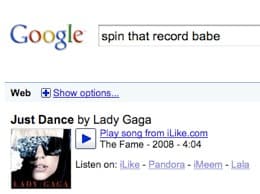
Done and done. Although it already allows contextualized research by music for a long time (just add in a search the term “music:”), from now on the Google Music Search integrates in the results of research (in the USA - see final note) by artist, album or music, the possibility of listening to excerpts, lyrics, watch video clips, get bibliographies of bands, buy online music or concert tickets.
Like almost all recent Google releases (e.g. Google Books, Google Voice, Google Social Search, etc.), the implications for this market are immense. By allowing online purchases to be made at iLike (recently purchased by MySpace ) or Lala Google becomes a huge sales force for these two players. Implications?
- ** Threaten the leadership of iTunes**
 With the help of iPod and iPhone, Apple's iTunes has become not only the main destination for buying online music but also the barometer for the success of songs, artists and albums.
iTunes represents about 25% of all music sales in the American market (online and offline). According to CNET, in online sales iTunes leads with 69%, followed by Amazon with 8%.
But the music market is far from static and iTunes is far from having a safe market share. In addition to the threat of streaming new players (such as Pandora, Last.fm and the recent and brilliant Spotify), Google's entry into this market does not represent a new product or another step to take for those who want to find music. On the contrary, it offers the immediate discovery of music in a natural way, without thinking. The discovery of music becomes naturally integrated into the research experience, with the main results appearing at the top of the page.
By allowing online purchases to be made on iLike and Lala, Google ends up being responsible for the entry of these players into the impenetrable iTunes market. In turn, iTunes has no way of counterattacking, since it cannot compete with Google in searches.
- *Google Music Trends (Top Google?)
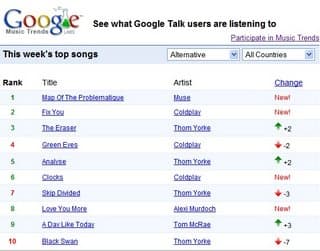 The Tops have always been important to the music market. If previously it was the Billboard top 100, today are (also) iTunes Tops.
Google has always measured trends (see Google Trends ). If we combine data from 6% of searches Google already had on music with what users “hear”, and the “what” and “when” buy, we have data that gives accurate information about the music industry.
We can easily imagine an extension to Google Trends that redefine the concept of Top 100.
- MySpace: It’s alive!
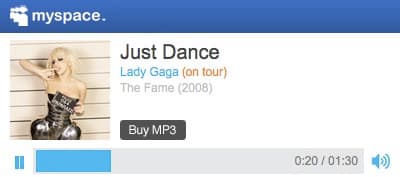
After being Facebook's leading competitor, MySpace was beginning to be compared to some kind of Titanic from the online world.
Although it has repositioned itself as a social network centered on the universe of music, being the stopping point of numerous bands, having today an excellent video service and having a new CEO, MySpace traffic has been falling brutally (as Facebook grows from day to day).
After buying iLike to start having your music store, MySpace now has Google as a sales force and is reborn as a stop site for music-related audiences. It's a case to say “With the blessing of Google!” or “In Google we trust!”.
-
- ♪ Even more recipes ♪
 The deal made with iLike and Lala is more than a “good boys” deal. Of course, Google is targeting Facebook (it has already begun to do so slowly with its subtle but tempting strategy of social networks and now favors the former competitor) and iTunes has a... uncomfortable dimension.
But the truth is that Google wins with every sale made and it was easier to negotiate margins with iLike and Lala than it would with iTunes. And whoever buys a song after a Google search doesn't care who they buy it from.
And Google still reinforces advertising revenue in a sector that is still used to offline media.
Within two to three years, it will be curious to look at the recipes generated by Google in the music universe!
- Google Video 2.0
 Think of the satisfaction of wanting to hear a song that we partially remember and find in seconds. It is the kind of experience that cannot be intellectualized. This is an emotional experience.
Now imagine the satisfaction of any consumer when the video content is available in this way. It's not YouTube. It's not Hulu. It's every video, movie, videoclip, news, interview, available at a distance from a survey.
Google Search is now part of the Internet ecosystem. If we imagine what will happen when millions of people learn to research music, the video will be a natural extension.
An extension Google has been pursuing for a long time. It started with Google Video, with failed deals with television channels, with the purchase of YouTube. And since Google has size and cash-flow enough to have patience and wait... it's only a matter of time!
Note: The results of music surveys only present the possibility of listening to music (and buying) in the US. To “see” the complete results of a search, you have to use an American proxy "o. "
*Note 2: About a week ago I commented on Twitter Google Music Search. I didn't do it right on the Blog because lately it seems like Google is a unique theme. Either I'm too attentive to Google or Google is too active (sincerely, I don't think Google is active but... hyperactive!)... until when the state of grace? Where are the antitrust gentlemen? Something tells me this is going to be Google's biggest challenge in the short term. *