Articles

Page 13.

Ten articles per page, newest first.

01

Articles on page 13

Thoughts, stories and a few ramblings.

  1. 5 min read

    Conversational Marketing—or Marketing as It Should Always Have Been

    Conversational Marketing Of all the paradigm changes that the Internet has brought us, the biggest change turns out to be what I consider a correction and natural evolution of previous paradigms: ** the ability to interact. **

    Marketing and Communication (including advertising and sales here) was no longer based on “monologists” who imposed communication in a sense, from brand to consumer, to become something more natural, something more aligned with the very nature of communication: ** the dialogue**.

    Marketing stopped being about “telling a story and selling” and became about “listen, tell, listen and sell”.

    The “Conversational Marketing” (insist on foreignism because “conversational” does not sound good to me) is fully linked to “participation” (“Participation Marketing” would be a good translation).

    In the admirable new world of this Marketing 2.0 (yes, there is also a 2.0 here, which includes “Conversational” and “Social Networking”), there are some good practices to take into account and can make the difference between success and mediocrity:

  2. 1 min read

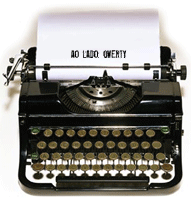
    On the Side: The QWERTY Keyboard

    QWERTY Keyboard

    In a Googliano world where everything is accelerated; where there is broadband; new media; iptv; 3.5G... there are also idiosyncrasies (juro!). And some that are part of our day-to-day like... our PC keyboard!

    The QWERTY keyboard, which owes its name to the first 6 letters of the first row of keys, was designed with a key distribution that forces people to write slower.

    By distributing these 6 keys (of frequent use in the English language) on the left side of the keyboard, right-handers confuse and write slower.

    This Machiavellian strategy aimed, in the old times of the typewriter, to prevent the most frequent keys from getting stuck when pressed into quick successions!

    Additionally, typewriter vendors could quickly type the word TYPEWRITER as the letters that compose it are in the top row.

    More than 100 years later, in World War II, the famous ENIGMA (German encryption machine) would have as first 6 letters QWERTZ. As the “code” in “German” was no longer reached... someone decided to give the final touch: “What if we switched... a key?”

    Times change, but the speeds do not change.

  3. 2 min read

    On the Side: Business Cards

    Image not recoveredCards Visit Business cards have always been a drama to me. They pile up. They pile up. They multiply. They blend in.

    Today, I remembered to look for the “History” of these pieces of paper.

    Apparently, they were created in the 17th century in France. But further research made me find references dating back to the 15th century in China.

    In any of the cases, they were titled “Visiting Cards” (around here, they were always “Visit cards”), they acted as a kind of invitation and were used for any purpose in which a quick writing was appropriate.

    They quickly evolved to “Trade Cards”, providing information about companies/shops and included a map with location.

    With the development of printing methods I have become an increasingly popular way of distributing contact information and advertising about a particular person/company. Around here, they remained as “Visit cards”. That way... “Visiting cards”.

    In the last (many) years the format has not changed much. More or less creative, with less or more color or types of paper. And with the world changing around us, why haven't these annoying pieces of paper changed? The answer is simple: although they seem like a thing of the past, they remain a simple and efficient way of distributing advertising about a business (not even that business is the “I”).

    Of course we have several ways to store “contacts”. From the PC, to various web services, CRMs and... the most used: Mobile. Despite this, the “paper piece” remains necessary and these new formats only increase the drama by creating another need: synchronization.

    There was a time around 2000 when I actually believed in a change. It was in the expansion period of the Palms. I remember my Palm V (it never gave me so much pleasure to have a 'gadget') and that at almost every meeting there was someone who also had one. This always served as an “unlocker” when instead of exchanging “paper pieces”, we pointed the Palms at each other, carried the button and heard the sound of transferring personal contact.

    Why don't mobile phones, increasingly the new type of Swiss pen, have a “send my contact” key? Something that was universal between brands? Nokia, SonyEricsson, Motorola, Samsung, HTC, whatever... a key!

    I leave a big announcement that made me look for my old man. Palm V:

  4. 3 min read

    Customer 2.0

    Customer 2.0 Web 2.0, Enterprise 2.0, Business 2.0, voice 2.0... The term “2.0′′ is the most commonly used Internet buzzword. It is so current to be “2.0′′” that to distinguish ourselves, we want to be “3.0′′... whatever that is. In this admirable new world of Online we are so tied to technology that sometimes we forget the simplest and most important things. And no matter how you go, branding, marketing, advertisation, online, offline... “it’s all about the customer”. And speaking of 2.0, there's a new client out there... Customer 2.0. I don't know what you think, but I... I want to talk to him. Professionally, everything I do these days is so I can talk to him and him.

    Who is Customer 2.0? It's new and alive! He's one of the most demanding clients we've ever had to deal with. You know why? Because the 2.0 customer expects us, the market, to grow and appear.

    Customer 2.0 calls us to make your Internet experience fun, social, addictive. If he uses our services today, there's no guarantee he'll use them tomorrow. This customer is brand loyal, but my website will draw your attention if he does so to his community; his group; his tribe.

    • Welcome to the age of oblivion!

    And don't expect this Customer 2.0 to be happy with your simple site (much different from a simple site!). He learned web design in high school, learned all about the new ways of unionizing. He learned all about how to aggregate content, how to make his own “mashups”. It is a generation that divides between Googles (the coolest and smartest) vs Yahooyanos (less aggressive, less knowledgeable but equally intelligent). For this client... we either have to offer you something really new or you will feel offended, either by the lack of “professionalism”, or by “trust”.

    For your site to be your meeting point, it is mandatory to offer “competence” and “irreverence”.

    One thing is certain... all this fashion of “2.0′′, depends and is pushed by this “client 2.0′′”. The first step in realizing this world 2.0 is the knowledge of this new customer. Before we work on any idea, project, business, it is important to start by listing the needs of this new client and reacting to their needs. Then, and only then, to implement. And forget about the traditional IT project. This 2.0 client is also the “ 2.0 Beta customer”. He's willing to test and participate in development. You're not willing to wait.

      • Rule number 1 of “world 2.0′′: Do first, correct and improve next. **

    And in fact... no matter how many turns you get to the definitions of Marketing, IT, Branding, Sales, etc.... It's all so simple, so basic. It all comes down to the old man: “The customer first!”

    • Back to the basics 2.0?
  5. 3 min read

    Who Was Customer 1.0?

    Okay, Customer 1.0 still is. But I want to talk about the “Customer 2.0” and, now taking on a boring Post, it makes sense to create some context and define who is the “Client 1.0”.

    In the old world pre “2.0”, the customer was only a number in the business plan of most companies. In the world of Internet and IT, Client 1.0 was someone who:

    • Buying software packages;

    • Installed this software and maintained it;

    • paid for updates;

    • He owned and controlled his data;

    • It had significant initial fixed costs with the purchase of software;

    • it took time to use due to the need for demand-purchase-send-installation;

    • I found it hard to switch from one software to another.

    Customer 1.0 is served by a traditional software selling model that has the following characteristics:

    • Low volumes / Significant transactions;

    • Quantity is a more important feature than quality;

    • indirect sales channels through partners or dealers;

    • High barriers at entry and exit;

    • Expert and fragmented customer support;

    • Structured price and product models.

    Trends in the environment 2.0:

    • Software market much more competitive and aggressive;

    • growth of digital content;

    • Internet (and broadband) proliferation;

    • Computer clouds (Cloud computing);

    • Social networking;

    • collaboration;

    • Web 2.0 Mashups;

    • Code-savvy users;

    • Online Advertising presenting successful business models.

  6. 1 min read

    Still the “Word of Mouse”...

    Image not recoveredWoM Interestingly, after posting the previous post, they sent me a link to a Karlus Blog post which has everything to do with "Word of Mouse", but... misapplied.

    Without much effort, Karlus, who, although I do not know, consider an intelligent type, in a post about Optimus’ new image “strangered” some comments too “obvious”; too “promotional”.

    It was enough to see in the blog logs the origin of the posts, arriving (almost) immediately to Media Planning, a company belonging to Havas, owner of Euro RSCG, company responsible for the new image of Optimus

    This is a good example of how Buzz generated by the “Word of Mouse”, if mismanaged, can turn against Marketeer or Publicitarian.

    In 2005, Vichy created in France a character (Claire) on a Blog about anti-aging, managed by a Marketing team. It took only an hour for bloggers to discover and start accusing the brand of presenting a fake character.

    The blog was closed immediately and relaunched later in a different format, using only real users discussing real issues. Vichy made an apology to the Blogger community but despite being difficult to measure, the damage was done.

    In case of Euro RSCG...not only are these actions no longer new, but one cannot understand how an experienced and competent team commits these gaffes...

  7. 1 min read

    Anonymous: “Different vote”

    And speaking of paradigm changes... sometimes the roles reverse and it’s the “Consumer 2.0′′ himself doing well what the agencies are up to.

    One of the most spoken announcements in the American presidential was not made at the request of any of the candidates nor even passed on television. But the “Word of Mouse” effect has been seen millions of times and has already been news.... on the news.

    Originally an “anonymous” advertising was actually created by Phil de Vellis who made the entire announcement, alone, on his computer, from an ad that was already a classic: Apple “1984′′.

  8. 2 min read

    New paradigms for Brand Activation: “word of mouth” and “word of mouse”

    Image not recoveredWoM Those who follow developments online realize that the great paradigm shift these days turns out to be exactly the fusion between worlds. Although there is an “online” and “offline”, it no longer makes sense to think about “worlds” or “borders”. The world of advertising and communication is probably one of the first worlds to reflect this “evolution”.

    If at the end of 80, on the American market, it was enough that an announcement was in the air three times to reach 80% of the population, today it is necessary to be on the air 150 times. Although television remains a relevant advertising medium, maintaining previous levels of efficiency has a much higher cost.

    On the other hand, the consumer is much more sceptical, more informed, questions everything and finds intelligent ways to look beyond marketing and advertising actions. Online has offered these new consumers tools to unite and share ideas and knowledge. Tracking a Web 2.0, we now have a Consumer 2.0.

    They changed the means and changed the consumer. Advertising and Marketing are now required to change methods and approaches and take advantage of this new “Consumer”.

    Following this “Consumer 2.0′′ a new trend emerges in Marketing called “Word of Mouse” (WoMo), defined as “the act in which the consumer receives, creates and/or distributes relevant marketing content through online channels (textual or audiovisual)”.

    WoMo is a part of the buzz required for any Brand Activation action, creating conditions for the consumer himself to provide information about brands, products and services to third parties in an informal and non-commercial manner. WoMo represents the online component of “buzz”, extending the offline component “word of mouth” (WoM), i.e. mouth-to-mouth.

    Today’s Marketeer and Publicitarian, in the creation of “buzz”, is obliged to think about the unification between online/offline. In fact, this unification presents new challenges for the entire market in communication and advertising as it requires not only to exploit new campaigns but also to measure their efficiency.

    Traditional online and offline metrics are not enough. We are obliged, rather than evaluating audiences and clicks, to measure behaviors and attitudes. Not creating the buzz, we cannot ignore the dynamics created. The success of a campaign depends on a global analysis involving content generated by the consumer himself. We need to measure what happens in the “post” campaign; to value visualizations, diffusion and creation.

    We need new methodology and analysis frameworks.

  9. 1 min read

    Manifest

    Explaining the goal of a Blog is ungrateful. A Blog is a blog. A way to “share” ideas and visions.

    And this is all I want with “this” Blog: to share part of the BySide Vision, the project where, with part of the best team I have gathered along my professional path, we develop this vision of a world where the boundaries between Online and Offline are increasingly less relevant.

    In this new world of Web 2.0, Customer 2.0, Voice 2.0, where we are “people” who count, the BySide project also in a way represents a “reset” against past projects. A way to continue to do the same, to continue to innovate, efficiently and focused... in version 2.0.